CLIENT AREA
Stop buying shares on headlines.
Company analyses where every figure leads back to the original filing. Three courses that teach you to read them without us. And tools you fill with your own numbers.
3 analyses, 39 lessons, 4 calculators no lock-in 30-day guarantee
YOU KNOW THE FEELING
Someone else's opinion cannot be checked.
You read a headline, someone praises the company on a podcast, you buy. A month later it is down a fifth and you cannot tell whether that is an opportunity or a mistake — because you never had your own reason, only theirs.
You try to learn and run into two things: either someone is selling signals and portfolios to copy, or it is a six-hundred-page textbook you will never finish. Nothing in between.
So you keep paying for other people's opinions. Not in subscription fees — in decisions you had no way to check.
ANALYSES
A write-up where you can redo every number yourself.
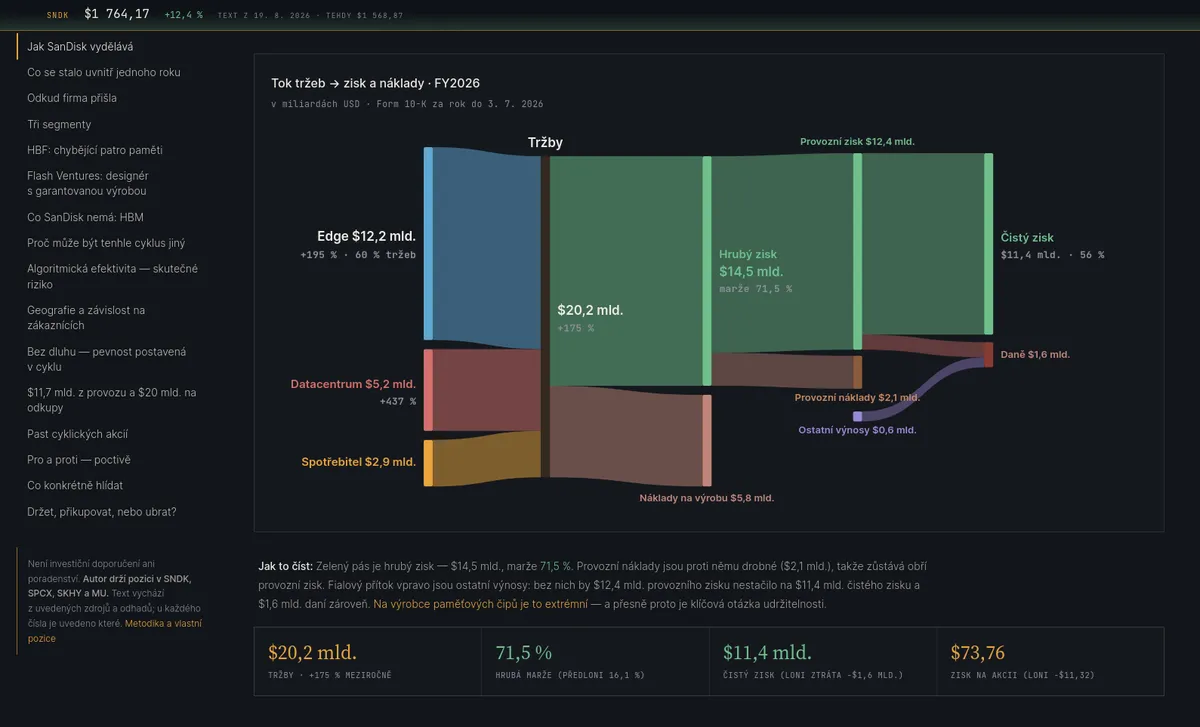
SpaceX, SanDisk, Palantir and Cloudflare — with more arriving. Each analysis takes apart where the company's money comes from and where it goes, with the cash flow drawn from revenue all the way to the bottom line.
EVERYTHING INSIDE
COURSES
Three courses, 39 lessons
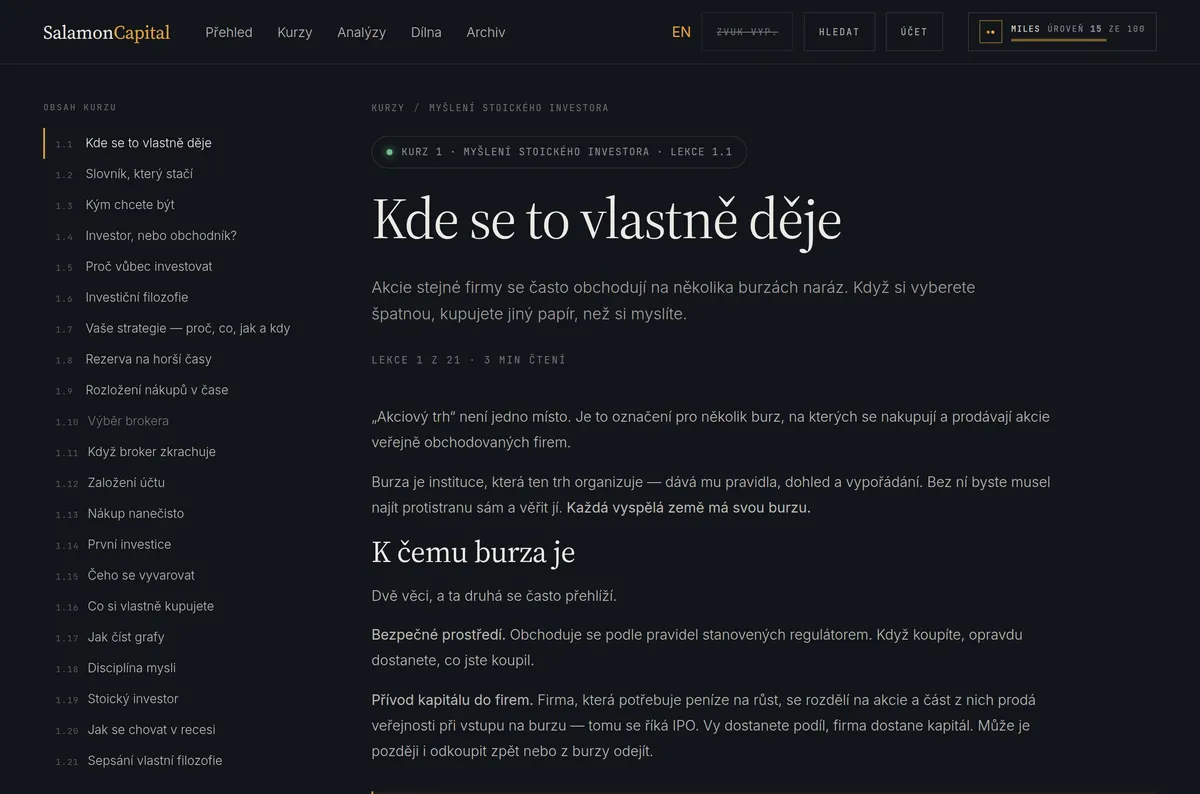
From “what is a share, really” to reading an income statement and a balance sheet. Each lesson is written for one sitting and builds on the one before — none assumes you already know something from a later one.
Show the curriculumHide the curriculum
1The stoic investor's mindset
21 lessons
- 1.1Exchanges and markets
- 1.2Eighteen terms you will keep meeting
- 1.3Where your money is supposed to come from
- 1.4Investing vs. trading
- 1.5Time is money — start now
- 1.6What holds you when everything screams sell
- 1.7Rules, so that emotion does not decide
- 1.8A broken washing machine will force you to sell
- 1.9How to stop guessing whether it is expensive
- 1.10Fees are not what will cost you most
- 1.11Your shares survive. Your cash has a ceiling.
- 1.12Twenty minutes and three things nobody else asks for
- 1.13A demo account does not test your strategy. It tests you.
- 1.14Small enough to survive. Big enough to teach you.
- 1.15Four mistakes, and not one is picking the wrong company
- 1.16You cannot buy an index
- 1.17How charts deceive
- 1.18When panic takes over
- 1.19Acting sensibly when you do not control the outcome
- 1.20The difference is made in the year everything is red
- 1.21Nine questions and one page against rash decisions
2First-principles analysis
10 lessons
- 2.1A thesis without the second half is enthusiasm in paragraphs
- 2.2Spotting a good business before the chart does
- 2.3Two companies sell the same thing and are different investments
- 2.4Why people pay more for the same thing
- 2.5The decision you will see in the filing two years later
- 2.6By the time it is news, someone has already traded on it
- 2.7The order of questions in which each one makes sense
- 2.8The best ideas are not on the screen
- 2.9The prepared half is marketing. The other half is not.
- 2.10The best way to beat the competition is to stop competing
3The world of numbers
8 lessons
- 3.1Buffett's eight numbers, and four times they fail
- 3.2How easily you bend the number your way
- 3.3Two hundred pages, and the company knows which you will read
- 3.4Everyone knows it. Almost everyone uses it wrong.
- 3.5Undervalued, or just fallen
- 3.6Not a penny richer, and the price still rises
- 3.7Profit grows, your share of it shrinks
- 3.8Profit is an opinion. Cash is a fact.
WORKSHOP
Four calculators, your numbers
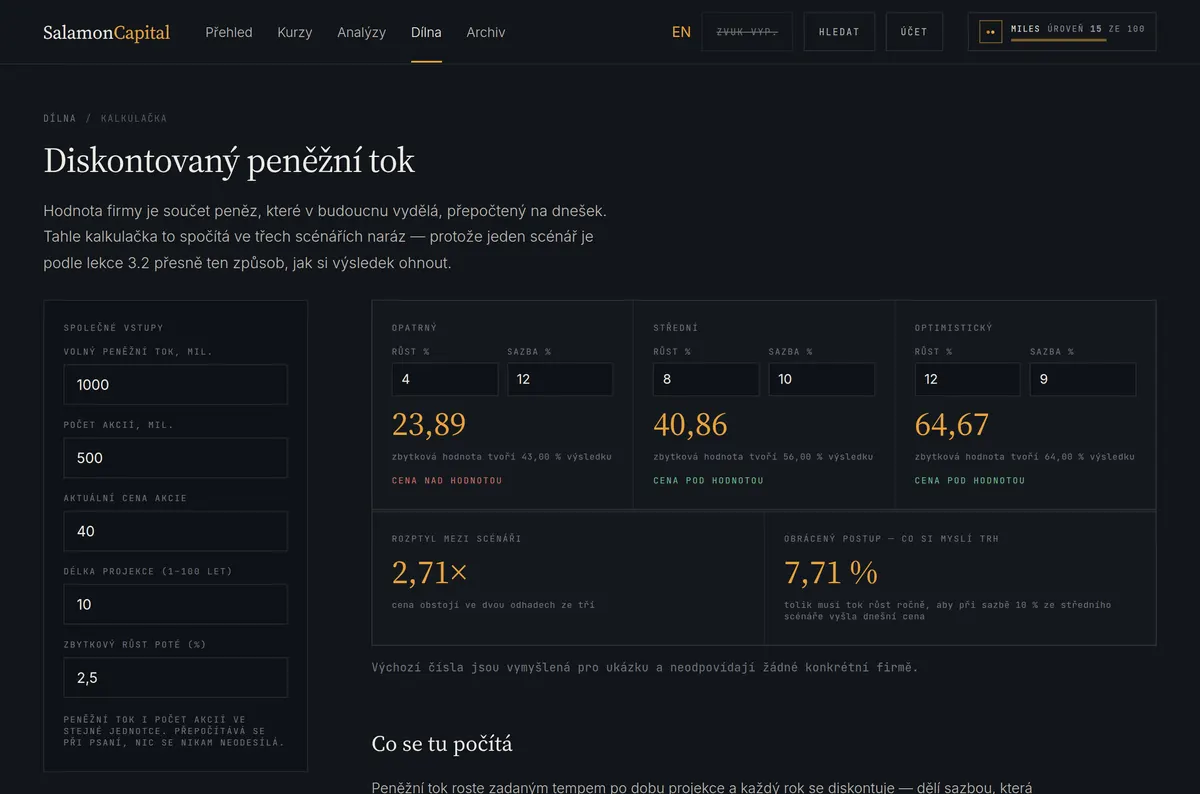
How to work out what a company is intrinsically worth, discounted cash flow across three scenarios, eight numbers from the statements, and dilution against buybacks. Our calculators walk you through it.
Replace the sample figures with your own; it computes in your browser and nothing is sent anywhere, so what you calculate stays with you.
FUNDAMENTALS
Any company that files with the SEC
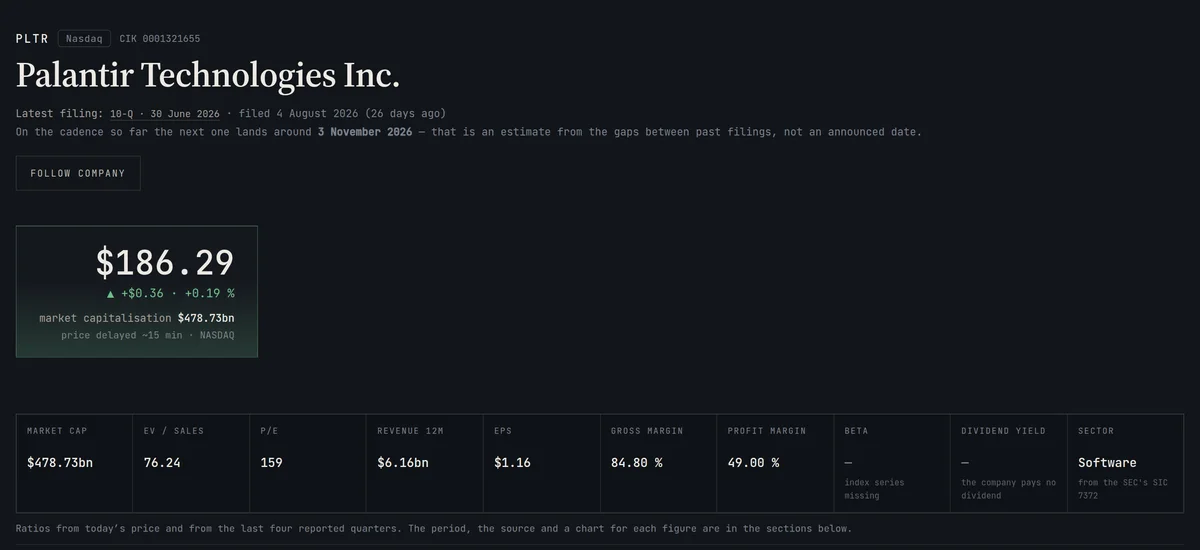
Type the company's ticker and you have the profile, income statement, balance sheet, cash flows, revenue split by segment and country, valuation and risks — from the SEC archive, not from a transcription.
Every figure shows which filing it came from and for what period. The link goes to the document itself, so you can read it at the source.
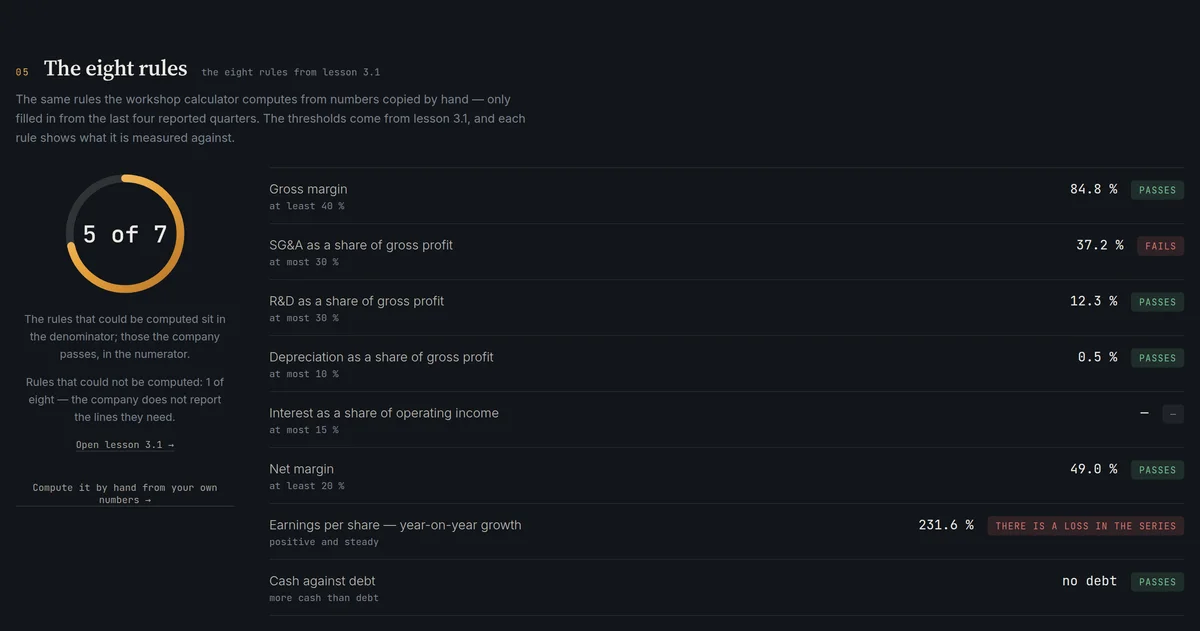
The eight rules, filled in for you
The same thresholds the course teaches you to work out by hand — filled in from the last four reported quarters. Each one shows the threshold, the measured value, and why the verdict came out as it did.
What the tool cannot work out, it says so. A blank is an answer, not a failure — a bank has no working capital, and a zero would claim it has nothing to pay with.
PROGRESS
Every lesson you finish counts. And it shows.
Every finished lesson, completed course, company taken apart and calculator filled in earns experience and moves you up: eleven ranks, a hundred levels, a new rank every ten levels. Each has its own mark, and the top five carry metal — bronze, silver, gold and, at the summit, Augustus.
From recruit to Augustus. The mark changes, not just the number, and you wear your rank in the section bar whatever you open. Every course you finish brings the summit a year closer.
THIS IS FOR YOU IF

Filip Salamon
Founder · The Stoic Investor
YOUR MENTOR
In 2012 I entered a national investing contest — as someone else, because I was too young to qualify. I finished in the top twenty out of thousands, up 326 % in three months. Then I told myself it had been luck and that only professionals could really do this.
My friend Leo from Laniakea Partners changed that. He sat down with me and showed me how he worked. I bought my first share and stopped hesitating, because I knew what I was doing.
This course is that mentor. It cuts the learning curve in half, you learn from their mistakes, and you act with more confidence because someone who has already done it is guiding you.
The course is the mentor I needed when I started investing, written down in the order I needed it.
PRICE
The tool, the write-ups, the course.
The course teaches you to read a filing. The analyses show what that looks like done on a real company. Qvestor lets you do it on any company that files with the SEC. Qvestor is a subscription, Analyses an add-on to it, and the Course is paid once.
Qvestor
$19
a month · or $190 a year, two months free
- Any company that files with the SEC
- Growth, margins, balance sheet, revenue split, insiders
- Screener, comparison, watchlist and your broker portfolio
Analyses
+$12
a month on top of Qvestor · $31 together
- Companies worked through from the filing up
- A source and a period next to every figure
- The author's position in every company
Course
$129
once · for good, no subscription
- Three courses, 39 lessons
- Four calculators in the Workshop
- Progress and ranks — for good, no subscription
The price is final. We are not registered for VAT, so nothing is added to it. No lock-in; it ends whenever you want, at the close of the paid month.
Whatever is added to that part — a new analysis, a new lesson, a new tool — is included. It is not another purchase.
Thirty-day guarantee — with one condition
Within thirty days, send me one filled-in calculator or one thesis on a company, written using the procedure from the course. It does not have to be good. It has to be yours.
If it still gave you nothing, I refund you, no further questions.
Why the condition: this is not a course you consume in an afternoon. Someone who never tries it has no way of knowing whether it helps — and a guarantee without the work pushes me to write for people who do not read.
Your statutory right of withdrawal is unaffected; this guarantee applies on top of it.
BEFORE YOU ASK
I am a complete beginner. Will this be over my head?
The first course starts at what a share is and why it is worth anything at all. It assumes nothing — not that you know what P/E means, not that you have ever opened a filing. If you already have the basics, the first few lessons take an evening and you miss nothing, because the order is fixed and the lessons build on each other.
How much time does it take?
A lesson is written for one sitting, roughly twenty to thirty minutes. Thirty-nine lessons is therefore two to three months at two evenings a week. There is no point rushing; each lesson builds on the one before.
How often do analyses arrive, and what if I only want those?
There are three now and more are written as they come. Membership covers the whole section — analyses, courses and workshop — because a write-up reads better once you know how it was built, and that is what the course teaches. There is no analyses-only plan yet.
Is this investment advice?
No. Nothing in the section is a recommendation to buy or sell, and nobody here assesses your situation. It is courses, write-ups and tools — material for your own decision, not a substitute for making one. Every analysis states whether I hold the stock.
How do I pay, and how quickly do I get in?
Ask for access with the form below and you get an e-mail with payment details within two business days. There is no payment gateway wired up yet, so the first month is settled by bank transfer; I then add access manually for the address you give. The section is gated by e-mail sign-in, so there is no password to invent.
Can I cancel any time?
Yes. There is no lock-in and membership ends at the close of the paid month. The progress you built up stays saved to your account — come back and you pick up where you left off.
PLAINLY
Nothing in the section is investment advice. It is courses, write-ups and tools — material for your own decision, not a substitute for making one. Past results are no guarantee of future ones, and nobody here is promising you a return.